How to Complete Court-Mandated Counseling Requirements
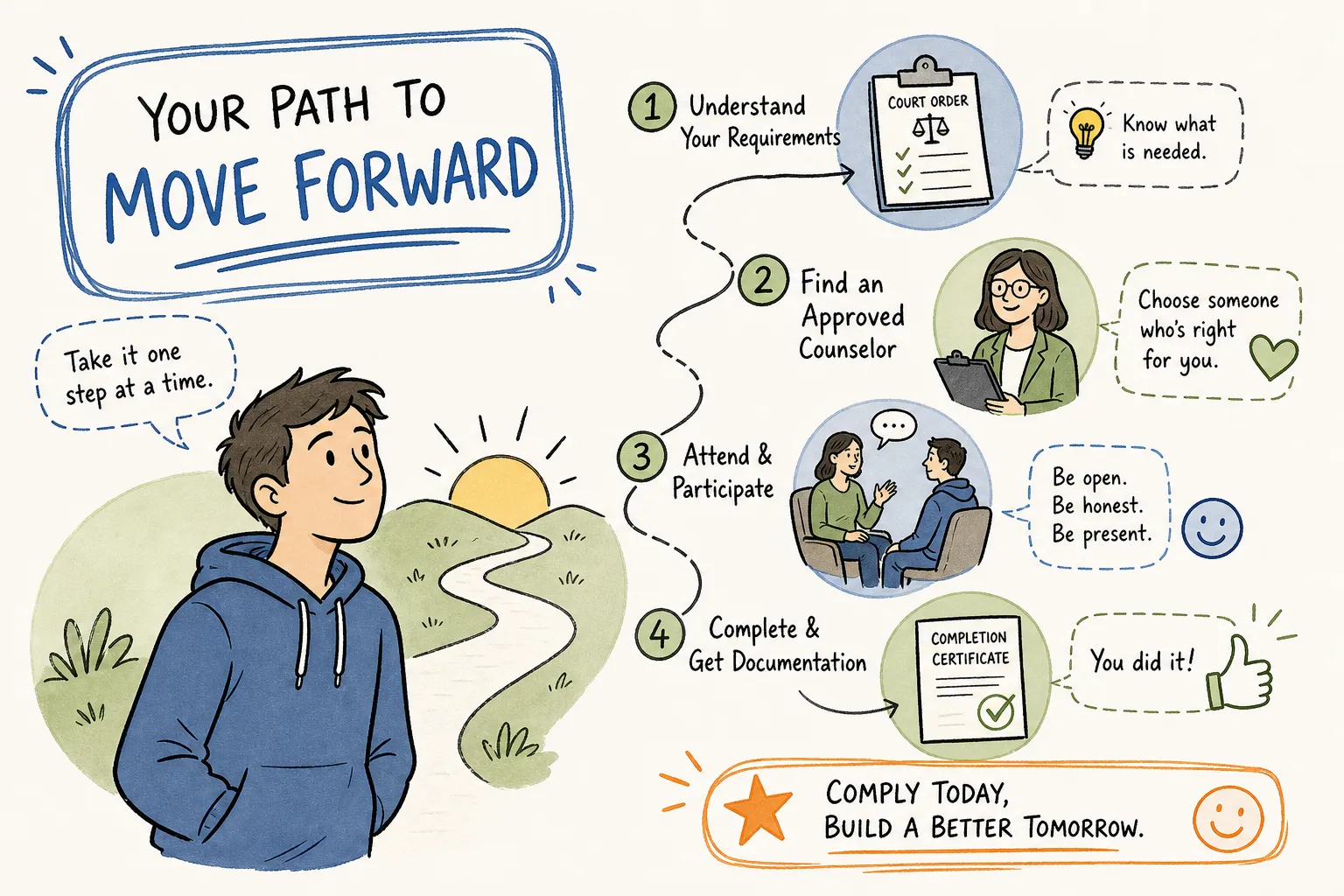
If you’re asking how to complete court-mandated counseling requirements, the answer starts before you call a single therapist. Receiving a court order for counseling is unsettling. The language is formal and dense, the stakes are high, and the order rarely explains what you actually need to do next. People commonly contact therapists before verifying court approval, and that single misstep can force them to restart the entire program. Understanding the process before you begin is most of the work.
Clients who end up back in front of a judge, or who have to restart a program from scratch, tend to stumble at the same predictable points: failure to verify provider approval, missing or incorrect paperwork, and gaps in attendance documentation. This article walks through six phases: reading your order correctly, verifying your provider, building a clean attendance record, securing your paperwork, handling missed sessions, and avoiding the two structural mistakes that most often derail compliance.
If you are navigating a family court case in Oklahoma and need a licensed, court-experienced therapist who understands documentation from the ground up, The Owen Clinic works directly with clients in exactly these situations. The steps below apply regardless of where you are in the process.
What Your Court Order Actually Requires, and Why So Many People Misread It
Reading the Order Before You Call Anyone
Before you do anything else, sit down with the actual court order and locate five specific elements: the program type, the required session count or hours, the completion deadline, who receives the documentation, and whether the court specifies any credential requirements for the provider. These details are not interchangeable. A court that orders 12 hours of a structured domestic violence intervention program will not accept 12 sessions of general talk therapy as a substitute. Program type and program specificity both matter, and courts routinely reject paperwork that documents the wrong service entirely.
Pay close attention to how your deadline is framed. Most completion deadlines are tied to a specific event: an upcoming hearing date, a probation review, or the entry of a final decree. They are not open-ended calendar windows. If your order says “before the final custody hearing,” that hearing date is your hard stop.
How Timelines Vary by Program Type
The three most common mandated program types differ significantly in time commitment. Parenting and co-parenting education programs are typically the shortest, often running 4 to 12 hours total and sometimes completed in a single session. Basic DUI or substance education programs range from a few hours to several sessions depending on offense level and jurisdiction. Court-ordered substance abuse treatment and domestic violence or batterer intervention programs are structured weekly programs that typically run for several months.
These ranges vary by jurisdiction. Your court order is the only authoritative source for what applies to your case. General internet research on program lengths can give you context, but it does not override what the order says.
How to Complete Court-Mandated Counseling Requirements: Finding and Verifying an Approved Provider
Start With the Court, Not an Internet Search
Provider approval is jurisdiction-specific. Your court does not automatically approve a therapist holding a valid state license for court-ordered services; confirm approval separately through the court clerk. To find out who is actually approved, contact the clerk, probation officer, or family court services administrator who handles your type of order and ask for the approved-provider list and the approval criteria. Then verify the provider’s license status independently through your state licensing board.
Oklahoma family court, for example, can require educational programs and counseling as conditions of custody cases, and compliance is tracked through certificates and provider reports. A provider who is unfamiliar with those specific reporting requirements can create paperwork problems even when attendance is perfect.
What to Ask a Potential Provider Before Your First Session
Once you have a candidate provider, ask these questions before scheduling. Are they experienced working with clients referred by this court or jurisdiction, and are they familiar with its documentation requirements? Can they provide court-ready attendance logs, progress reports, and a completion certificate on official letterhead? If telehealth is relevant to your situation, have they confirmed with the court that telehealth sessions satisfy this specific order?
The Owen Clinic’s direct experience with family court documentation and court-involved cases in Oklahoma is exactly the kind of background to look for in a provider. A therapist who already knows how to structure reports, what language courts expect, and how to communicate with probation officers significantly reduces your risk at the back end of the process.
Showing Up and Building a Clean Attendance Record
Why Consistency Is Your Most Powerful Compliance Tool
Courts and probation officers do not evaluate compliance by counting the final session tally alone. They look at attendance patterns over time. Consistent, on-time participation signals good faith and cooperation. Erratic attendance, even if you eventually reach the required total, raises questions that consistent attendance never does. Your attendance record should show session-by-session dates, total hours where relevant, and your provider’s signature or verification for each entry.
If your order requires periodic progress reports to the court or a probation officer, confirm that your provider knows this from day one. Do not wait until the final session to discover that mid-program reports were supposed to be filed at the 30-day and 60-day marks.
What Telehealth Sessions Require for Court Compliance
Many courts now accept court-mandated therapy delivered via telehealth, but acceptance is not automatic and is not universal across program types. Before your first telehealth session, confirm in writing with the court or probation officer that telehealth satisfies your specific order. Once that is confirmed, make sure your provider documents each session with your name and location at the start of the session, the modality used (audio-video or audio-only), the provider’s credentials, and a clear attendance entry. A telehealth session that lacks proper documentation carries the same risk as a missed session when paperwork is reviewed.
Getting the Completion Paperwork Your Court Will Actually Accept
What to Request From Your Provider Before Your Final Session
Courts accept specific documents as proof of completed mandated counseling. You need three things: a completion certificate that includes your provider’s name, credentials, completion date, and total sessions or hours; a final progress or discharge letter confirming you completed the required treatment; and attendance logs or a provider letter on official letterhead documenting your participation across the full program. The clerk will likely reject a plain receipt, an informal note, or an undated summary.
Request your documentation well before any court deadline, often one to two weeks or more, depending on your provider’s caseload. This gives your provider time to prepare it accurately and gives you time to review it for errors before it is filed. A missing case number, an incorrect date, or an absent signature is among the most common reasons court clerks reject counseling paperwork outright.
How to Submit Documentation and Confirm It Was Received
Filing the paperwork is not the finish line. You need to confirm that it was actually received and entered into the correct case. File with the court clerk, provide a copy to your probation officer or family court services caseworker if required, and keep a time-stamped personal copy of everything you submitted. Then follow up before your hearing date to verify receipt. Courts reject filings for missing case details, bundled PDF errors, and missing signatures; a quick verification call can catch any of those problems while there is still time to correct them.
What to Do If You Miss a Session or Fall Behind Schedule
The First 24 Hours After a Missed Session Matter Most
A single missed session rarely triggers automatic legal consequences, but it becomes a problem the moment you ignore it. On the same day or the following morning, contact your provider, request to reschedule, and ask for written confirmation of that outreach. Suppose your probation terms require you to notify your officer of absences; document that communication as well. Acting immediately and creating a paper trail is the difference between a remediable gap and a compliance violation.
How Courts Typically Respond to Gaps in Attendance
Courts and probation officers evaluate patterns and effort, not a single data point. The escalation path for unaddressed noncompliance runs from required explanations at a compliance review, to ordered make-up sessions, to increased supervision or treatment intensity, and, in cases of repeated or ignored absences, to sanctions including fines, contempt findings, or revocation of probation. In most jurisdictions, courts are more likely to treat a gap as remediable when the person acted quickly, communicated proactively, and can show documented good-faith effort to get back on track.
Mistakes That Routinely Derail Compliance
Starting With a Provider Before Confirming Court Approval
This is the single most costly mistake in the process. Sessions completed with an unapproved provider cannot be counted toward your court order. There is no retroactive credit. If you complete 10 sessions with an unapproved therapist and the court does not accept them, you restart the clock with your deadline unchanged and fewer days remaining. The provider verification process outlined earlier in this article can often be completed within a business day and prevents this outcome. Still, timing depends on court responsiveness and local procedures, so start it immediately.
Treating Paperwork and Deadlines as Afterthoughts
Completion certificates and provider reports take time to prepare, especially when a provider carries a full caseload. Waiting until the week before a hearing to request your documentation is one of the most avoidable failure points in this process. Request a mid-program progress report early so any gaps in your attendance record can be identified and corrected before the final document is prepared. Building in lead time, generally one to two weeks, though more is always better, is a practical precaution, not just an end-of-program step.
Completing Your Requirement With Confidence
Knowing how to complete court-mandated counseling requirements comes down to following six phases in order. Read your court order carefully and identify every specific requirement. Verify your provider with the court before scheduling a single session. Attend consistently and let your provider build a clean attendance record. Request completion paperwork well before any deadline. Act within 24 hours of any missed session. And sidestep the two structural mistakes, using an unapproved provider and leaving paperwork to the last minute, that cause more compliance failures than anything else combined.
Court-mandated therapy, handled with intention, can be genuinely useful rather than just a legal obligation. The structured sessions and measurable goals are the same elements that make any good therapeutic process work. The legal requirement creates the initial structure, and the documentation makes that progress visible to the court.
Choosing an appropriate, court-experienced provider at the start often makes the difference between smooth compliance and a hearing complication. If you are in the Oklahoma City area and need a licensed clinician who understands documentation requirements, reporting obligations, and the specific dynamics of family court cases, The Kevon Owen Christian Counseling is ready to help you build a compliance plan before your next hearing date. Call or visit us online to schedule an intake and get started
Kevon Owen – Christian Counseling – Clinical Psychotherapy – OKC
10101 South Pennsylvania Avenue, Suite C
Oklahoma City, Oklahoma 73159
405-655-5180 – 405-740-1249
The post How to Complete Court-Mandated Counseling Requirements appeared first on Kevon Owen, Christian Counseling Clinical Psychotherapist.

No comments:
Post a Comment